Content Loading & Certification
Merging two enterprise systems into one unified platform.
TL;DR
Two legacy enterprise systems served the same products and the same users, but they didn't know about each other. Users had to navigate between them, re-enter data, and hold two separate mental models for tasks that belonged to the same product lifecycle.
I led the design of the unified replacement: a single platform where onboarding, validation, certification, and reporting connect into one end-to-end journey. The work covered information architecture, workflow consolidation, a reusable UX pattern library, and scalability planning for future modules.
The platform is in the tail end of production. Early signal from PMs, user testing, and internal review suggests the unified IA is landing. The bigger outcome, which is harder to measure but more important, is that we replaced two disconnected mental models with one.
Background
The work spanned two legacy enterprise systems that managed different parts of the same product lifecycle. One handled product content loading, GTIN management, bulk data ingestion, and onboarding workflows. The other handled compliance documentation, regulatory workflows, and certification tracking.
Although both platforms worked with the same products and the same users, they operated in isolation. Moving between them required re-entering data, learning conflicting interaction patterns, and managing disconnected status views. This created real operational friction at enterprise scale.
The mandate was to merge them. Not visually, but structurally. Into a single platform that simplified how brands, manufacturers, suppliers, and compliance teams managed product information across its full lifecycle.
Role
Lead designer. I initially partnered with one other product designer, then took over as sole design owner. The work covered product experience strategy, information architecture, workflow and interaction design, UX pattern standardization, and scalability planning. Roughly a year of focused work across multiple phases.
The problem
Three challenges sat in tension and shaped almost every decision that followed.
Fragmented user experience. Users navigated between systems, learned different interaction patterns, re-entered information across modules, and managed disconnected workflows. The experience felt operational rather than intentional.
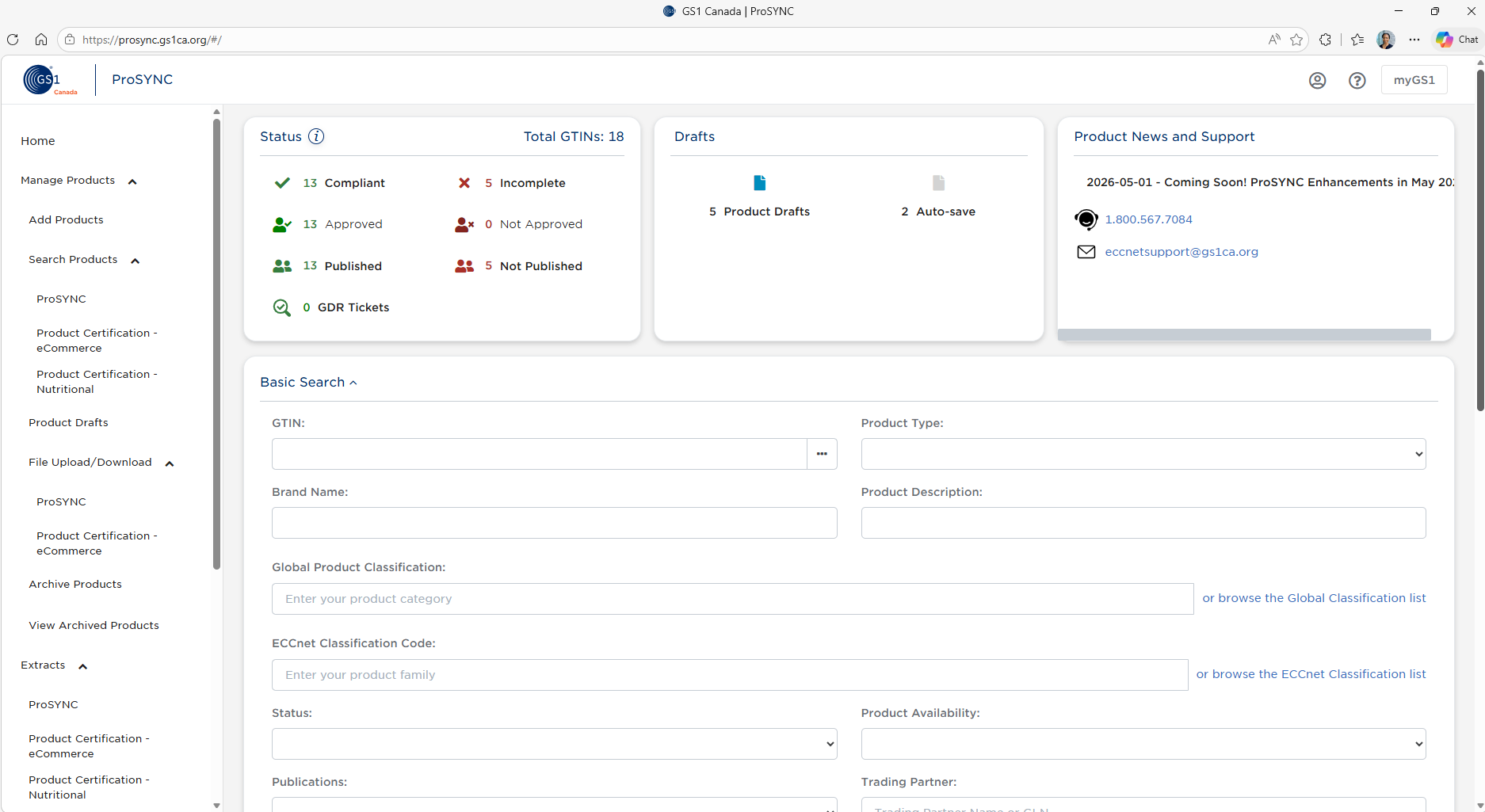
Legacy enterprise patterns. Both systems reflected legacy enterprise design. Dense interfaces, heavy table-based workflows, limited guidance, inconsistent UI behaviors, and poor discoverability of actions and statuses.
Complexity at scale. Enterprise users handled thousands of SKUs per upload, certification dependencies, multi-step onboarding, and validation errors. Any pattern that worked for ten products had to survive at ten thousand.
Understanding the users
I began with stakeholder alignment and workflow mapping across both legacy systems. The goal was to understand how users actually worked, not how the systems assumed they did. The research surfaced patterns that shaped every major design decision.
Users were not explorers. They entered the platform with a specific, immediate operational goal and needed to complete it quickly. The experience had to get out of their way.
Three discovery insights:
Users prioritized efficiency over exploration. Every session had a clear intent. Upload data, resolve an error, check certification status, extract data, run a report. Navigation had to support rapid execution, not discovery.
Visibility was non-negotiable. The most common frustration wasn't “I can't do this.” It was “I don't know what's happening.” Users needed immediate clarity on product status, pending actions, validation errors, and certification progress across both workflows at once.
Bulk operations were the core use case. Managing thousands of SKUs, large-scale uploads, and batch validation weren't edge cases. They were the primary workflow. Scale had to be a first-class design consideration, not an afterthought.
The goal
A unified enterprise platform where users could onboard, manage, validate, certify, and monitor products through one simplified end-to-end experience. No moving between systems. No re-entering data. No holding two separate mental models for tasks that belonged to the same lifecycle.
The initiative focused on workflow consolidation, simplified navigation, unified information architecture, scalable UX patterns, and turning fragmented operational tools into one coherent platform that could grow with the business.
Design approach
Rather than modernizing each system in isolation, the redesign started from user goals and worked backwards to determine what the platform needed to be. This reframe shifted the structure from system-centric to task-centric. Instead of “go to ProSync for uploads” and “go to Certification for compliance,” users could simply manage products, resolve issues, and track certifications from a single unified environment.
Process step 1: Requirement alignment. Early stakeholder conversations resolved filtering logic, search placement, dashboard hierarchy, action card behavior, and workflow ownership before design began. This prevented costly late-stage pivots.
Process step 2: Workflow mapping. Mapping overlapping user journeys across both systems identified shared goals, duplicated steps, cross-platform dependencies, and consolidation opportunities. This shifted the frame from “two systems to modernize” to “one experience to unify.”
Process step 3: UX pattern standardization. Establishing a unified component system early (tables, filters, status indicators, empty states, action cards) created platform-wide consistency and reduced cognitive overhead.
Process step 4: Scalability thinking. Every structural decision considered future modules, multi-content type support, certification workflows, and AI-assisted validation. The architecture had to grow without being rebuilt.
The redesign
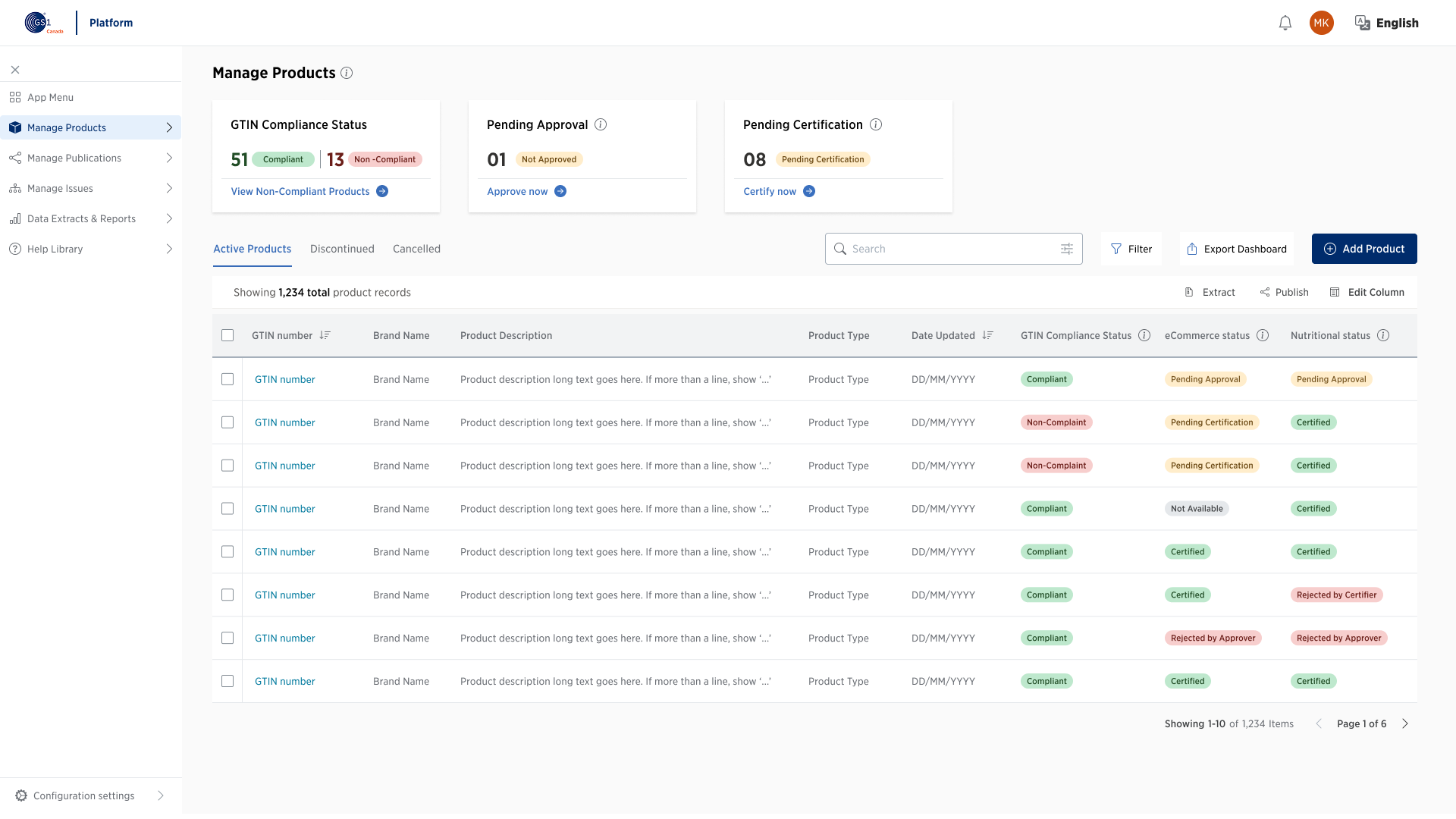
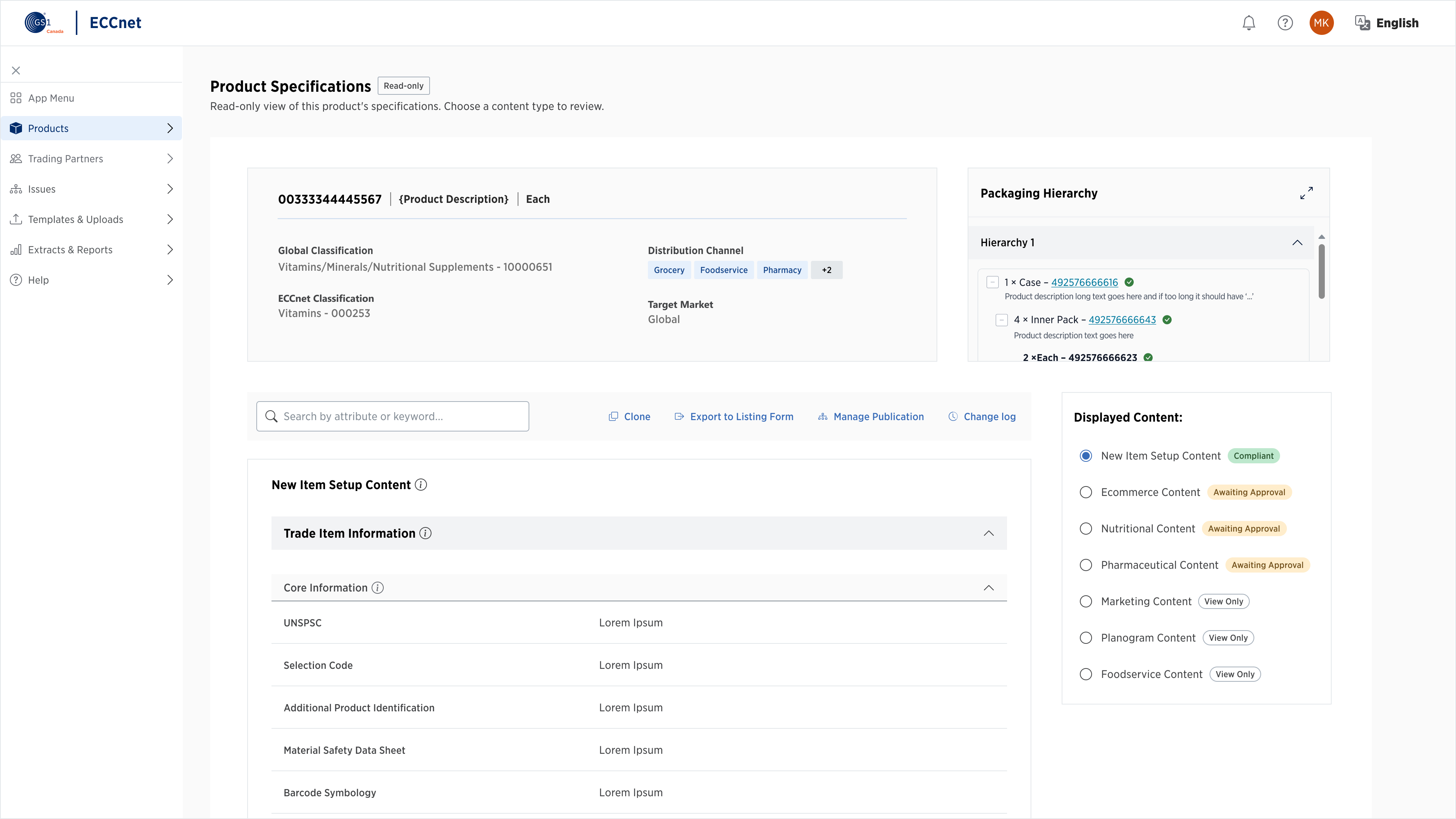
The shift from system-centric tables to a task-oriented, visibility-first unified platform. The screens below show the change in thinking, not just aesthetics.
Outcome and early signal
The platform is in the tail end of production. Early signal from PMs, user testing, and internal review suggests the unified IA is landing in the ways it needed to.
A product manager noted that the unified dashboard finally helps users identify what needs to be done and understand exactly where they are within the product data lifecycle. The IA does what two disconnected systems couldn't.
In user testing, participants kept returning to two things: clearer navigation, and excitement about the new interface relative to the legacy one. The shift from operational to intentional was readable to them.
Internal reviewers highlighted that clear, actionable statuses reduced user friction. Where there had been two systems with disconnected data and no shared workflow, there is now one with synchronised data and a unified flow.
Platform impact (design and structural outcomes):
- Two disconnected systems unified into a single, coherent platform with one navigation model and one source of truth for product status
- Product onboarding, validation, certification, and reporting connected into a single end-to-end journey
- A reusable UX pattern library established across tables, filters, status indicators, and action cards
- Architectural headroom built for future modules
Key learnings
Platform mergers are primarily a thinking problem. Consolidating two systems isn't a visual design challenge. It's a systems thinking challenge. Resolving conflicting mental models and data relationships had to precede any visual work.
Enterprise simplicity isn't subtraction. Making something feel simple doesn't mean removing complexity. It means understanding it deeply enough to hide it behind clarity. The goal was surfacing exactly what's needed, exactly when it's needed.
Consistency is a feature. In platforms used daily at enterprise scale, predictable behavior isn't a baseline expectation. It's a competitive advantage. Inconsistency costs trust, and trust is slow to rebuild.
What I would explore next
Role-based personalization. Different users have fundamentally different priorities. While some role-based actions and views are already available, the next evolution would adapt the dashboard and navigation to specific roles: role-based dashboard views, personalized task prioritization, configurable workflow shortcuts.
AI-assisted validation. Rather than surfacing errors after upload, the platform could guide users toward prevention by predicting issues based on historical patterns and offering contextual guidance in real time: predictive error detection, inline validation guidance, context-aware suggestions.
Deeper lifecycle intelligence. Product status already tells users where a product sits in the data lifecycle today. The next layer is understanding it across dimensions: how complete its data is, how its certifications depend on each other, and how it's progressing across workflows over time. One score that combines all of it would give users a single answer to “where does this product stand.”
- Product readiness scoring
- Certification dependency mapping
- Cross-workflow progress tracking